decora-kei
is a fucking joke.
decora-kei, as it exists now, is completely divorced from its roots. it is an attempt to emulate something that does not exist. the main sources on it are very very full of misinformation because of this muddy and completely recent vision. i am truly saddened by this fact.
in the first place, デコラ is not short for decoration. the japanese pronounced decoration as de-ko-ree-sho-n, and they are perfectly capable of shortening that to de-ko-ree. if decora was written as デコレ, we would just as easily be saying decoré similar to the way we pronounce anime.
what we write as "decora" in english is actually supposed to be interpreted as decorer. decora-kei means "decorer-style", as in the style that decorers wear. yes, people who wore this style once had a subculture, rather than being a group of online people spouting "no rules". there's a history behind this term and fashion, as with any other—and nobody who claims to be an expert seems to know it.
it all goes back to the label nagomu records. i know that everything is nagomu records with me, but i am entirely serious: nagomu records is the reason you can wear your rainbow vomit now.
keralino sandorovich is a musician, playwright, producer, director and actor. he's an all-around creative. in 1983, he was just kera the musician. in 1983, he started a record label for his band and others.
our dear label owner kera was stylish. his fans were too. the girls (and boys) who loved nagomu records all wore pretty eccentric fashion: patterned tights, denim, twin-tails, bracelets, primary-colour printed tees, rubber-sole sneakers especially.
there was variation, of course—in fact, some fans dressed completely differently to what i have described, but they were still identifiable. bright and fun and punk. something different in our early-80s japan.
these fans were called nagomu gals, or more broadly, nagomu kids. as a subculture, it was all nagomu-kei; nagomu style.
over time, this subculture went extinct. it's completely gone now, despite the bands and their fans still existing. but the style was punchy enough to stick around at least a little bit, and the idol tomoe shinohara held onto this "nagomu gal" look. she was vibrant and fun. she wore lots of denim, put her hair up cute, adorned plenty of bracelets and went on stage as her pure self.
naturally, her fans loved her. the girls loved her so much they wanted to be her. and so these obsessive fans started to emulate her: bright colours, bracelets, necklaces, several hair clips. you didn't have to wear very many accessories to get the look down, but you were recognisable as a fan just from your appearance.
fans of tomoe shinohara were called shinorers. there was a trend in japan, to add "-er" to the end of subcultures. furries, for example, like kemono characters, so they're called kemoners.
but the rer thing originates from a devotee of the brand chanel being a chaneler—this word is pronounced in japanese as sha-ne-ra, and so the "ra" was borrowed. this can be seen in the word menhera too, short for mental healther. it's more natural for a japanese person to say ra in this case.
of course, the style a shinorer wears is eventually going to be called shinorer-kei: shinorer-style. these days, people who trace the origins of decora-kei as far as shinohara will half-incorrectly dub the style as shinora kei. it was a really cute style.
shinorers didn't have to dress the same as shinohara forever. in any good and healthy subculture, there is experimentation: in experimentation, new identities can emerge. the more accessories shinorers put on, the more defined the colour palettes and use of patterns became, the more that people who weren't even shinorers wore the style, the more the style was decided to be decorer-kei.
from here, "decora" was born. these people were decorers because they were people who loved deco. i hope that, by now, you see clearly why the ra in decora is completely unrelated to the word decoration.
this no longer has anything to do with shinohara and certainly nothing to do with nagomu: in fact, decorers went low on the colours and maxxed out the patterns. they usually just wear pink on pink on pink. it's a cute style of its own at this point.
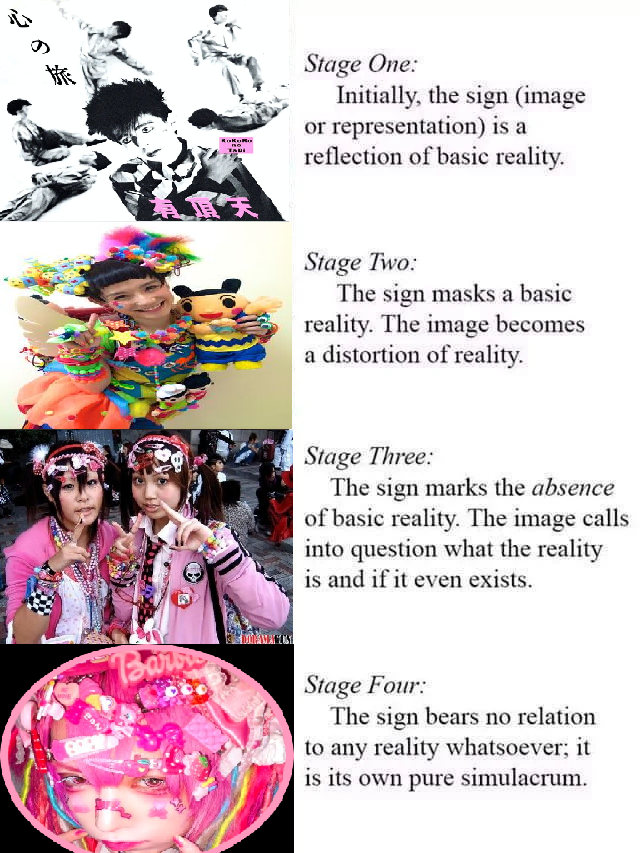
of course, modern decora-kei (or as i tend to call it, neo-decora) is different from the decorer-kei of old. it's inbred, a lot. people are no longer bringing their outside influences to the way they dress and upping the accessories.
by the mid-2010s, the options are either to be entirely rainbow or have one strong and eye-straining theme colour. decorers used to wear few accessories and create visual interest with patterned clothes; now, ten hairclips and twenty bracelets are all but required. if you miss the hairclips, you ought to make up for it with five necklaces.
neo-decora has no resemblance to the street snaps we all admire. in the modern day, there is not even such thing as a decora-kei community: the closest we have is influencers. one visual kei band, two online micro-celebrities, one popular western influencer. this is the new core of the neo-decora "movement".
decora-kei now exists entirely online. dare i say it is built on consumerism. the push that decora has no rules, which is true to an extent, has resulted in people fighting over what is right to do: in most cases, the person with a thicker skull is the one who walks out alive, ready to spew whatever misinformation they have decided on.
the japanese are looking to the western girls for inspiraton. the western girls look to each other for inspiration. sensitive youth who find j-fashion intimidating or expensive see an image of a subculture with no actual shared interests and think it is perfect to insert themselves into.
it's a mess, and frankly, the lack of "quality control" means it's an eyesore too. neo-decora is a fucking joke.